

December 2025 marked one of the busiest months in recent SEO history. Google rolled out several major seo updates touching artificial intelligence, search user experience, privacy, analytics, and core ranking systems. These changes impact search visibility, analytics strategies, data sourcing, and even legal considerations for SERP data mining.
Below, I have summarized each update.
What happened | Why it matters | What you should do
Google’s AI-Driven Search Changes – Preferred Sources Worldwide & Search Box Enhancements
What happened:
In December, Google expanded its Preferred Sources feature globally and enhanced the search box experience with more context-rich links and AI-powered suggestions.
Previously tested in limited markets, Preferred Sources now appears for more queries worldwide. This feature highlights specific trusted sites as authoritative sources for AI answers, news summaries, and rich results.
In addition, Google added more supplemental links directly in the search box as users type, offering deeper navigation options before search results even load.
Why it matters:
- Sites selected as preferred sources receive better visibility in AI answers and featured panels.
- Users can navigate to deeper topic pages more quickly, which may reduce reliance on the first organic result.
- Structured data, authority signals, and topical depth are now more critical than ever.
What to do:
- Review your content’s depth and expertise; create comprehensive topical clusters.
- Optimize entity-based schema (organization, person, topic).
- Strengthen internal linking to content related to core subjects where you want preference.
Web Guide Feature Enhancements
What happened:
Google previously launched the Web Guide, an AI assistant providing curated, step-by-step overviews on complex topics. The feature appears in relevant search results and offers interactive guidance.
Unlike traditional featured snippets, Web Guides can include expanded media, resource links, and procedural outlines.
Why it matters:
- Users spend more time engaging with Web Guides.
- Sites linked within these Guides can receive indirect visibility even without ranking in top organic positions.
- Brands can benefit from inclusion if their resources are referenced.
What to do:
- Publish how-to and guide content that is comprehensive and well-structured.
- Use clear headings, step breakdowns, visuals, and citations from expert sources.
Google Gemini – Not Showing Ads, No Plans Yet (Dec 9)
What happened:
Google confirmed that its AI model Google Gemini will initially not display ads in AI-generated summaries or interactions. There are no current plans to monetize Gemini responses with paid placements.
Why it matters:
- Organic visibility gains importance in AI search responses.
- Paid search professionals must anticipate future monetization models tied to AI engagement.
- For now, organic content quality and entity authority win over ad spend in AI search contexts.
What to do:
- Strengthen your content’s authority signals.
- Prepare content for AI consumption with a clear schema and fact-checked information.
- Track Gemini responses where your brand appears.
Google Data Manager API Launch — Dec 9
What happened:
Google released the Data Manager API as part of the DV360 Suite — integrating with Google Ads and Google Analytics 4 (GA4) for unified data governance and management.
This API lets marketers:
- Streamline campaign, analytics, and audience data.
- Enforce consistent rules across platforms.
- Automate reporting and audience creation.
Why it matters:
- Reduces manual friction in cross-platform setups.
- Improves data consistency and compliance.
- Supports advanced audience segmentation for better targeting.
What to do:
- Explore API integration for your analytics and ad teams.
- Align naming conventions and audience definitions across GA4, Google Ads, and DV360.
Monitor API limits, quotas, and permissions settings.
YouTube Partner Match Update — Dec 1
What happened:
YouTube updated its Partner Match settings. This change has raised concerns among privacy advocates while advisors and influencers see new opportunities.
Partner Match now allows:
- More granular audience sharing between platforms.
- Optional consent-based audience targeting.
- Improved privacy controls for end users.
Why it matters:
- Brands can match audiences more precisely across channels.
- Privacy teams should review consent collection and storage.
- Misconfiguration may expose data or violate policies.
What to do:
- Update privacy notices to reflect new Partner Match capabilities.
- Audit audience sharing consent records.
- Train marketing teams on privacy-first audience strategies.
Google Shows “Read More” Link in Meta Descriptions — Dec 19
What happened:
Google began inserting expanded “Read More” links in meta descriptions on SERPs.
When descriptions are truncated, Google now offers a tappable “Read More” link that expands the snippet in-place.
Why it matters:
- Users can see more of your description without clicking.
- Meta descriptions now influence engagement even more.
- Calls to action (CTAs) and structured descriptions perform better.
What to do:
- Rewrite meta descriptions with compelling first and second lines.
- Include primary keywords and a strong CTA early.
- Test structured snippets that encourage expansion clicks.
SERPAPI Data Mining Ruled Illegal — Dec 19
What happened:
Google filed a legal case asserting that mining SERP data via third-party APIs (such as SERPAPI) violates its terms and potentially copyright/contract law.
This raises legal risk for entities scraping or redistributing Google search results.
Why it matters:
- SEO tools and research services that rely on scraped SERP data may face legal challenges.
- Enterprises using third-party scraped data may face compliance or contract risk.
- Sites dependent on scraped rankings should migrate to authorized APIs.
What to do:
- Switch to Google-approved APIs (Search Console API, Custom Search API, etc.).
- Review vendor agreements for data sourcing compliance.
- Consult legal counsel on any proprietary SERP datasets.
Google AI Overview Enhancements
What happened:
Google improved its AI Search UX:
- “Read More” links can jump directly to AI explanations.
- Users can upload images directly into the search AI interface.
- AI now surfaces richer context and visual interpretations.
Why it matters:
- Image SEO and structured visuals become more important.
- AI surfaces content based on relevance and factual context.
- Brands may appear in AI conversations even if not top in traditional SERPs.
What to do:
- Add descriptive alt text and structured image markup.
- Produce explainers optimized for AI comprehension (clear facts, FAQ schema).
- Monitor AI answer placements separately from organic rank.
Google Search Console Now Reports Social Media Traffic – From Dec 8
What happened:
Search Console began showing social media referrals in traffic reports, a major change from earlier versions that only focused on organic search.
This gives better insight into how your social channels support search performance.
Why it matters:
- You can now correlate social engagement with search behavior.
- Organic + social campaign performance becomes easier to analyze in one place.
- Cross-channel attribution improves.
What to do:
- Use Search Console to explore social traffic trends.
- Optimize pages that perform well on social for improved search visibility.
- Coordinate social and SEO publication calendars.
December 11 Core Algorithm Update
This the Big SEO update in December 2025
What happened:
Google released a December 2025 Core Update, impacting rankings across global markets.
While Google never reveals exact details, signals likely emphasized:
- Depth and authority of content
- E-A-T (Expertise, Authoritativeness, Trustworthiness)
- Page experience improvements
- Avoidance of low-value thin content
Why it matters:
- Many sites experienced ranking shifts.
- Thin or generic content is likely to be dropped.
- Deep, topical content with real user value saw wins.
What to do:
- Perform content audits to remove or improve thin pages.
- Focus on topic clusters, not single-page keyword targeting.
- Strengthen author credentials and citations.
- Improve page speed and mobile UX.
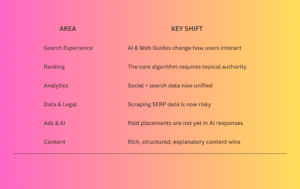
Summary: What All This Means for SEO in 2026
Final Thoughts on SEO Updates in December 2025
🔹 Treat AI interfaces as a search destination
🔹 Optimize metadata for engagement & expansion
🔹 Use official APIs for compliance and accuracy
🔹 Align social and SEO strategies
🔹 Audit content depth and authority continuously
🔹 Track AI answer placements alongside organic rank
Have questions about any of these SEO updates?
Drop your queries in the comments below, and we’ll help you understand how these changes impact your website and rankings.









Leave a Reply