


Evolution of Google Analytics
🔵 Urchin Analytics
🔵 Google Analytics Classic
🔵 Universal Analytics
🔵 Google Analytics 4
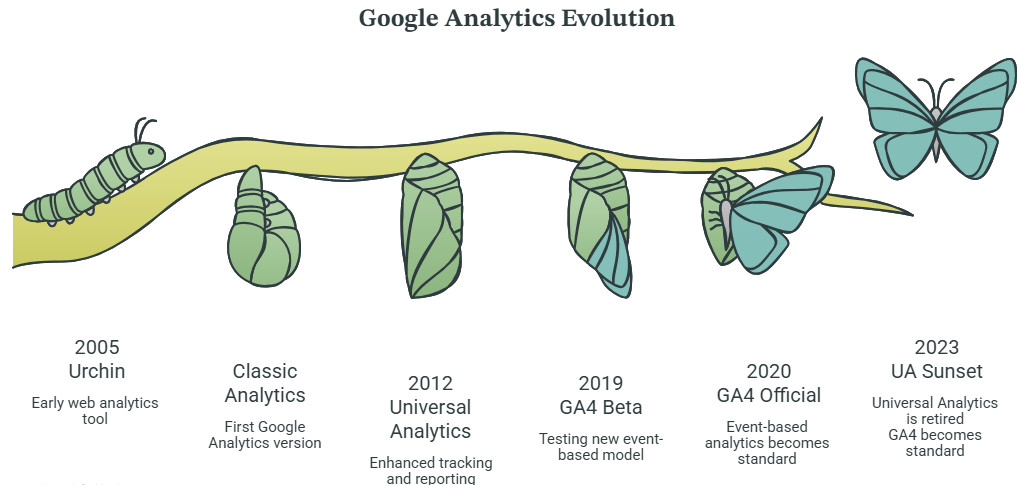
1. Urchin Analytics (1995–2005)
Before Google Analytics existed, there was Urchin Software Corporation, founded in 1995. Urchin developed a web analytics solution that analyzed server log files to provide insights into website traffic.
Unlike today’s analytics tools, Urchin primarily relied on server-side logs to track visitors. Website owners could monitor:
📊Website Visitors
🌍Visitor Geographic Location
🔗Referring Websites Most
📄Visited Pages
⏱ Website Traffic Trends
Key Characteristics
✔ Server Log-Based Analytics
✔ Basic Visitor Tracking
✔ Traffic Source Analysis
✔ Page-Level Reports
✔ Enterprise Licensing Model
Limitations
❌ Expensive Software License
❌ Difficult Implementation
❌ Limited User Behavior Tracking
❌ No Event Tracking
❌ No Real-Time Reporting
2. Google Analytics Classic (2005–2012)
In March 2005, Google acquired Urchin Software and transformed it into what became Google Analytics.
This was a turning point in digital marketing because Google made advanced website analytics free for businesses of all sizes.
Instead of relying solely on server logs, Google Analytics Classic introduced JavaScript-based tracking, enabling more accurate measurement of user interactions directly in the browser.
Major Innovations
✔ Free Web Analytics
✔ JavaScript Tracking Code
✔ Pageview Tracking
✔ Traffic Source Reporting
✔ Goal Tracking
✔ Campaign Tracking using UTM Parameters
✔ Integration with Google Ads
Businesses Could Answer Questions Like:
✔ Where are visitors coming from?
✔ Which pages are most popular?
✔ How long do users stay?
✔ Which marketing campaigns drive traffic?
✔ Which pages generate conversions?
Limitations
Although revolutionary at the time, Google Analytics Classic had several shortcomings:
❌ Focused almost entirely on pageviews
❌ Limited understanding of user interactions
❌ No cross-device tracking
❌ Limited customization
❌ Session-centric reporting
3. Universal Analytics (2012–2023)
As websites became more interactive and mobile applications gained popularity, Google introduced Universal Analytics (UA) in 2012.
Universal Analytics was designed to move beyond simple pageview tracking by introducing more flexible data collection and improved user identification.
Major Improvements
🚀 Custom Events
🚀 Custom Dimensions
🚀 User ID Tracking
🚀 Enhanced Ecommerce
🚀 Cross-Domain Tracking
🚀 Measurement Protocol
New Tracking Capabilities
Businesses could now track interactions such as:
🚀 Button Clicks
🚀 Downloads
🚀 Video Plays
🚀 Form Submissions
🚀 Product Views
🚀 Add to Cart
🚀 Purchases
Data Model
Universal Analytics introduced different hit types, including:
🟦 Pageview
🟦 Event
🟦 Social Interaction
🟦 Transaction
🟦 Timing Exception
Although much more powerful than Classic Analytics, UA still relied heavily on sessions as the primary measurement model.
Why Universal Analytics Was Eventually Replaced
Despite its popularity, Universal Analytics faced growing challenges:
Increasing privacy regulations (GDPR, CCPA)
Third-party cookie restrictions
Cross-device user journeys
Mobile app tracking limitations
Fragmented website and app analytics
Growing demand for predictive insights
Google needed an analytics platform built for the future.
4. Google Analytics 4 (2019–Present)
Google introduced Google Analytics 4 (GA4) as an App + Web Beta in 2019, officially launching it as the future of Google Analytics in October 2020.
Rather than improving Universal Analytics, Google redesigned the platform from the ground up. GA4 uses an event-based data model, where every interaction, whether it’s a page view, button click, scroll, purchase, or video play; is stored as an event.
Major Innovations
🚀 Event-Based Data Model
🚀 Cross-Platform Measurement (Web + Apps)
🚀 Machine Learning Insights
🚀 Predictive Metrics
🚀 Enhanced Measurement
🚀 Privacy-First Analytics
🚀 BigQuery Export
🚀 Flexible Explorations
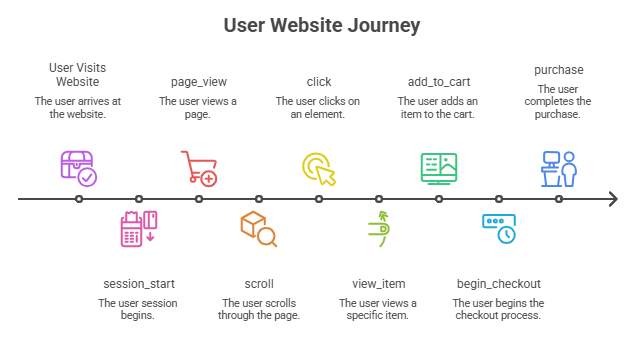
Instead of treating pageviews differently from events, GA4 records every interaction as an event, creating a more flexible and scalable measurement framework.
Why GA4 Is the Future
Google designed GA4 to address the needs of modern businesses:
⭐ Multi-device customer journeys
⭐ Mobile-first experiences
⭐ AI-driven insights
⭐ Privacy-focused data collection
⭐ Advanced audience building
⭐ Predictive analytics
⭐ Better attribution modeling
Why This Evolution Matters
Each generation of Google Analytics solved the limitations of its predecessor:
◆ Urchin introduced website traffic measurement.
◆ Google Analytics Classic democratized analytics by making it free.
◆ Universal Analytics expanded tracking with events, ecommerce, and user identification.
◆ GA4 reimagined analytics with an event-based architecture, AI-powered insights, and privacy-centric measurement.
Understanding this evolution helps explain why GA4 is fundamentally different from Universal Analytics. It is not just a newer version; it is a completely redesigned analytics platform built for today’s multi-device, privacy-conscious, data-driven digital ecosystem
Key Takeaways
✔ Google Analytics originated from Urchin Software, a server log analysis tool.
✔ Google Analytics Classic (2005) introduced free JavaScript-based website analytics.
✔ Universal Analytics (2012) added sessions, custom events, ecommerce tracking, and User ID capabilities.
✔ Google Analytics 4 (2019/2020) introduced an event-based architecture, machine learning, and cross-platform analytics.
✔ Universal Analytics officially sunset in July 2023, making GA4 the standard platform for Google Analytics.
✔ Understanding this evolution makes it easier to appreciate why GA4’s concepts; such as events, parameters, and user-centric measurement; are so different from previous versions.













Leave a Reply