

Technical SEO is often misunderstood as fixing broken links or submitting an XML sitemap. In reality, it forms the foundation of every successful website. Whether you’re managing a personal blog with 100 pages or an enterprise website with millions of URLs, technical SEO determines how efficiently search engines discover, understand, and rank your content.
When people think about SEO, they usually picture keywords, backlinks, or writing high-quality content. While those are undeniably important, none of them matter if search engines cannot properly access your website.
Imagine constructing a beautiful shopping mall in the middle of a desert without any roads leading to it. No matter how attractive the stores are, nobody can visit them.
That’s exactly what happens when a website lacks a strong technical foundation. Technical SEO creates those roads. It ensures Google can crawl your pages efficiently, understand your site’s structure, render your content correctly, and confidently include your pages in its index.
What Exactly is Technical SEO?
Technical SEO refers to the process of optimizing a website’s infrastructure so search engines can efficiently crawl, render, understand, index, and rank its content.
Unlike On-Page SEO, which focuses on content optimization, or Off-Page SEO, which emphasizes authority and backlinks, Technical SEO focuses entirely on how a website functions behind the scenes.
Think of SEO as constructing a modern office building.
- Content is the employees.
- Backlinks are the company’s reputation.
- Technical SEO is the architecture, electricity, elevators, plumbing, internet connection, security systems, and emergency exits.
Without those systems, the building simply doesn’t work. The same principle applies to websites. Google’s ranking systems can only evaluate pages that are technically accessible.
Why Technical SEO Matters More Than Ever?
Search engines have evolved dramatically. Fifteen years ago, simply publishing content with the right keywords could generate rankings.
Today, Google’s systems evaluate hundreds of signals before determining whether a page deserves visibility.
These include:
- Crawl efficiency
- Rendering quality
- Mobile usability
- Core Web Vitals
- Structured data
- Website architecture
- HTTPS security
- Page experience
- Internal linking
- Canonicalization
- JavaScript rendering
Modern websites are also significantly more complex.
A single ecommerce platform may contain:
- 500,000 product pages
- Millions of filtered URLs
- Dynamic JavaScript interfaces
- Personalized content
- Multiple international versions
Without technical SEO, Google wastes valuable crawl resources discovering duplicate pages instead of indexing the pages that matter most.
Understanding Google’s Journey Through Your Website
One of the biggest misconceptions about SEO is believing Google instantly “sees” a webpage after it’s published. In reality, Google follows a structured process that resembles how a librarian organizes books in a massive library.
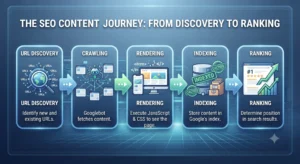
The journey typically follows five stages:
- URL Discovery
- Crawling
- Rendering
- Indexing
- Ranking
If something fails during any of these stages, the page may never appear in search results.
Let’s examine each stage in detail.
Stage 1: URL Discovery
Every page must first be discovered.
Google discovers URLs through:
- Internal links
- XML sitemaps
- External backlinks
- Previous crawls
- RSS feeds
A page without internal links or sitemap references becomes an orphan page.
Even exceptional content may remain invisible simply because Google never discovers it.
This is why site architecture is one of Technical SEO’s most overlooked ranking factors.
Stage 2&3: Crawling and Rendering: How Googlebot Explores Your Website?
Imagine Googlebot as an explorer navigating a vast city.
- Every webpage is a building.
- Every internal link is a road.
- Broken roads slow exploration.
- Dead ends waste resources.
- Clear highways improve efficiency.
- Google assigns every website a limited crawl budget.
- Small websites rarely notice this limitation.
- Enterprise websites with millions of URLs experience it daily.
For example:
An online retailer with 3 million parameter URLs generated through filters may unintentionally force Googlebot to spend most of its crawl budget on pages that provide little value.
As a result, newly launched products remain undiscovered for weeks.
Technical SEO solves this by optimizing crawl paths and reducing unnecessary URLs.
Stage 4: Indexing — How Google Decides Whether Your Page Deserves a Place in Its Search Library?
Discovering a page is only the beginning. Crawling allows Googlebot to fetch its content, but indexing is where the real decision happens.
Think of Google as the world’s largest digital library. Every day, billions of web pages compete for a place on its shelves. Just because a librarian picks up a new book doesn’t mean it will automatically be added to the library’s catalog. The librarian first checks whether the book is original, useful, complete, and worth keeping.
Google follows a very similar process. After crawling your webpage, Google’s systems analyze it to determine whether it should be stored in the Google Index. Only pages that make it into the index are eligible to appear in search results. If a page isn’t indexed, it doesn’t matter how well it’s optimized for keywords or how many backlinks it has—it simply cannot rank.
What Happens During Indexing?
Once Googlebot downloads your page, several automated systems begin evaluating it. These systems don’t just read the visible text, they examine the page’s entire structure and context.
Google looks at factors such as:
- The uniqueness and quality of the content
- Whether the page duplicates another page
- Canonical tags and preferred URLs
- Meta robots directives (index or noindex)
- HTTP status codes (200, 301, 404, etc.)
- Structured data and metadata
- Internal linking signals
- Mobile usability
- Page performance
- Spam and security signals
If the page passes these evaluations, Google stores it in the index, making it eligible to compete for rankings.
Stage 5: Ranking
Once a page is successfully indexed, it becomes eligible to appear in Google’s search results—but indexing doesn’t guarantee rankings. During the ranking stage, Google evaluates hundreds of signals to determine where a page should appear for a specific search query. These signals include content relevance, search intent, backlinks, page experience, Core Web Vitals, mobile usability, website authority, freshness, and user engagement. Google’s algorithms compare your page against competing pages to deliver the most helpful result. Pages that provide high-quality content, a strong technical foundation, and an excellent user experience are far more likely to achieve higher rankings and attract consistent organic traffic.
Real Business Example: An Enterprise E-commerce Website
A global fashion retailer had over 2.8 million URLs, but only 180,000 represented actual products.
The remaining URLs came from combinations of filters like color, size, brand, and price, creating massive duplication.
Googlebot spent the majority of its crawl budget exploring these low-value URLs instead of indexing new products.
After implementing Technical SEO improvements:
- Canonical tags consolidated duplicate content.
- Parameter handling reduced crawl waste.
- XML sitemaps focused on priority pages.
- Internal linking highlighted key categories.
Within three months:
- Indexed product pages increased by 35%.
- Organic traffic grew by 28%.
- Newly published products appeared in Google within hours instead of days.
This illustrates how Technical SEO directly impacts business performance.
Next Article : Technical SEO Work Flow ↗