

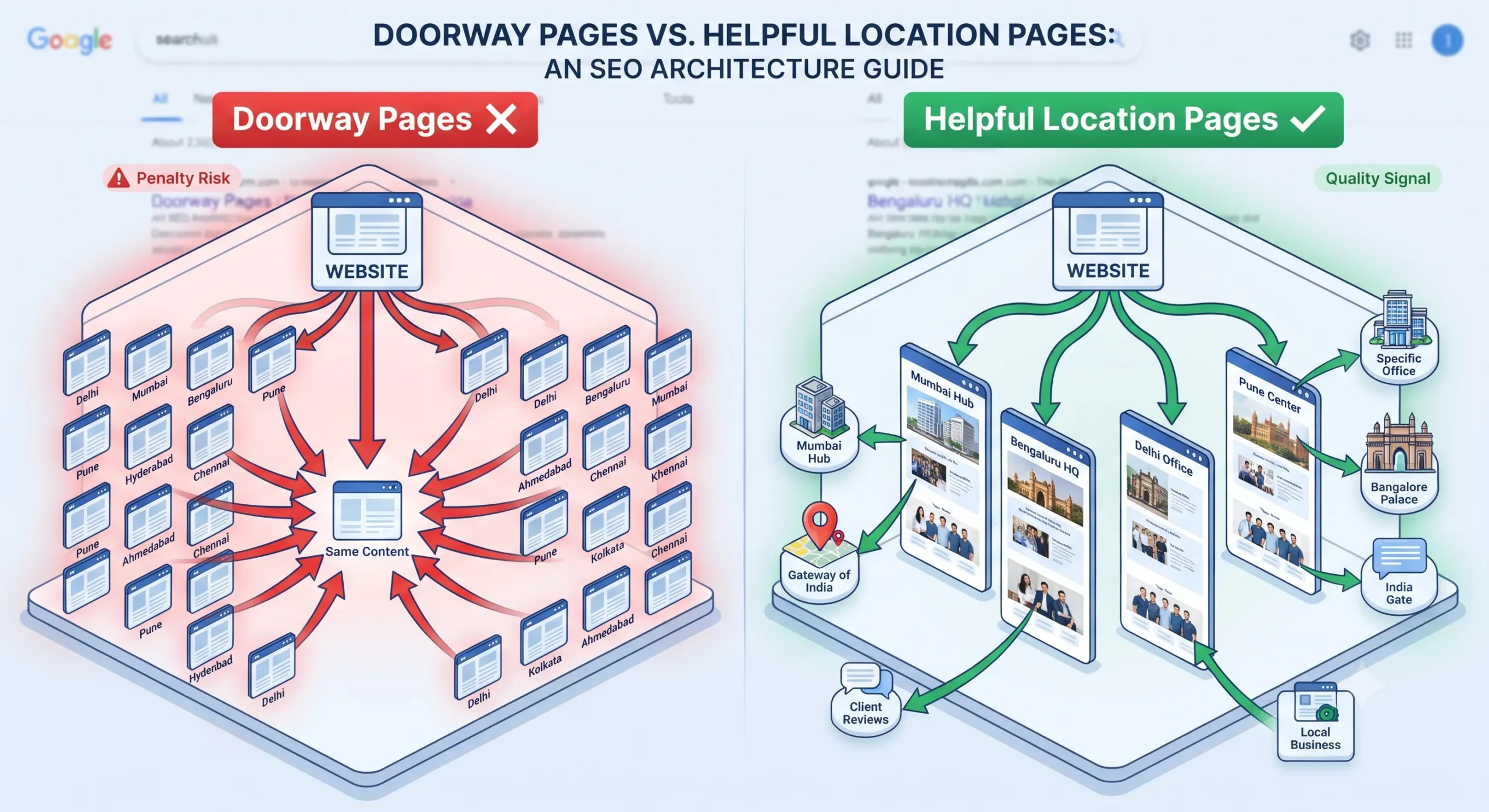
Imagine searching for “SEO agency in Mumbai” and landing on a page that promises specialized services for Mumbai businesses. Now imagine clicking on similar pages for Delhi, Bengaluru, Hyderabad, Chennai, and Pune, only to discover that every page contains almost identical content, with nothing more than the city name swapped out.
This is one of the most common examples of doorway pages.
Doorway pages are created to manipulate search engine rankings rather than provide unique value to users. They often target multiple keywords or geographic locations using nearly identical content, all funneling visitors toward the same destination. While this tactic once helped websites dominate search results, modern search engines, especially Google, consider it a violation of their spam policies.
In this guide, you’ll learn what doorway pages are, why Google penalizes them, how to identify them, real-world examples, and the best practices for creating scalable, user-focused pages without crossing into spam territory.
What Are Doorway Pages?
A doorway page is a webpage created primarily to rank for specific search queries and redirect users—either directly or indirectly—to another page or destination, without offering unique, standalone value.
Instead of solving the user’s intent, doorway pages exist solely to capture search traffic.
For example, a company offering one national service might publish hundreds of pages like:·
/seo-services-mumbai
/seo-services-delhi
/seo-services-pune
/seo-services-bangalore
If every page contains the same content except for the city name, they’re likely doorway pages.
Why Are They Called “Doorway” Pages?
Think of them as multiple entrances leading into the same room.
Each page acts as a separate “doorway” targeting a different keyword, but once visitors enter, they all arrive at essentially the same place.
Google considers this a poor user experience because users don’t receive content specifically tailored to their search.
Google’s Definition of Doorway Pages
Google defines doorway pages as pages or websites created to rank for specific, similar search queries that ultimately lead users to essentially the same destination rather than providing distinct value.
Common characteristics include:·
1. Multiple pages targeting slight keyword variations
2. Pages created solely for search engines
3. Nearly identical content across pages
4. Different URLs leading to the same business or conversion page
5. Large-scale keyword or location duplication
Why Doorway Pages Are a Problem
Doorway pages manipulate search rankings by creating artificial relevance instead of genuine value. For users, this creates repetitive search results. For search engines, it wastes crawl resources and reduces result quality. Google’s algorithms are designed to reward unique, helpful content—not mass-produced landing pages with minor text changes.
Common Examples of Doorway Pages
1. Location-Based Spam
A plumbing company serves only one city but creates hundreds of pages like:
1. Plumber in Jaipur
2. Plumber in Delhi
3. Plumber in Mumbai
4. Plumber in Pune
Each page has identical content except for the city name.
2. Keyword Variations
A page is duplicated for every keyword variation:
1. Best CRM Software
2. Top CRM Software
3. CRM Software Reviews
4. CRM Software Comparison
The pages provide the same information with only titles changed.
3. Affiliate Doorways
Pages created solely to rank and immediately send visitors to affiliate links without providing original reviews or analysis.
4. Multiple Domains
A company registers several domains targeting different cities or keywords, but every domain promotes the same business with nearly identical content.
How Google Detects Doorway Pages
Google doesn’t rely on a single signal. Instead, it evaluates patterns across your website.These include:
Duplicate Content: Large blocks of identical text appearing across many pages.
Template Abuse: Only city names, product names, or keywords change while everything else remains identical.
Funneling Behavior: Many pages direct users to the same conversion page or contact form.
Internal Linking Patterns: Doorway pages often have weak internal linking and exist only to capture search traffic.
Thin Content: Pages offer little information beyond what’s needed to insert a keyword.
Real Business Scenario
Poor Implementation
A digital marketing agency creates 300 city pages.
Every page says:”We are the best SEO company in [City]. Contact us today.”
The services, testimonials, FAQs, images, and case studies are identical.
Only the city changes.
This is a classic doorway strategy.
Better Implementation
The agency genuinely operates in multiple cities.
Each location page includes:·
1. Local office information
2. Maps
3. City-specific team members
4. Local case studies
5. Testimonials from nearby clients
6. Regional pricing
7. Local FAQs
8. Community events
9. Contact details for that office
Each page serves a unique purpose and provides value to users in that location.
Doorway Pages vs. Location Pages
Are Programmatic SEO Pages Doorway Pages?
Not necessarily.
Programmatic SEO is not the same as doorway pages.
Programmatic pages become problematic only when they:
1. Provide no unique information
2. Duplicate content at scale
3. Exist solely to rank
4. Offer poor user experience
High-quality programmatic SEO includes:
1. Original datasets
2. Dynamic statistics
3. Location-specific insights
4. Unique FAQs
5. Personalized recommendations
6. Valuable comparisons
How to Avoid Creating Doorway Pages
Before publishing hundreds of pages, ask:
1. Does each page answer a unique user intent?
2. Would users bookmark this page?
3. Does it contain original information?
4. Does it have unique media?
5. Would it still exist if search engines didn’t?
If the answer is “no,” rethink your strategy.
Best Practices to Follow
1. Create pages only when there’s genuine user value
2. Include location-specific or topic-specific content
3. Avoid keyword swapping in templates
4. Add unique images, reviews, FAQs, and case studies
5. Build strong internal linking
6. Consolidate duplicate pages where possible
7. Focus on satisfying search intent rather than maximizing page count
Final Thoughts
Doorway pages may seem like a quick way to target more keywords or locations, but they create a poor experience for users and violate Google’s spam policies. While they may deliver short-term visibility, they expose websites to ranking losses, manual actions, and wasted crawl resources.
The better approach is to build pages that deserve to rank. Every page should solve a specific problem, answer a unique search intent, and provide information that cannot simply be replicated by swapping a keyword or city name.
As search engines continue to prioritize helpful, people-first content, sustainable SEO success comes from quality, not quantity. If every page on your website offers genuine value, you’ll not only avoid doorway page issues but also build long-term trust with both users and search engines.













Leave a Reply