


Topics to Cover in this Chapter
1. What is Google Analytics 4?
2. Why was GA4 created?
3. How GA4 measures user behavior?
4. Why GA4 is different from previous versions?
5. Who should learn GA4?
6. GA4 Learning Roadmap!
What is Google Analytics 4 (GA4)?
Google Analytics 4 (GA4) is Google’s latest web and app analytics platform designed to help businesses understand how users interact with their digital properties across websites and mobile applications. Unlike Universal Analytics (UA), which primarily measured sessions and pageviews, GA4 uses an event-based data model, where every user interaction; such as a page view, button click, scroll, video play, file download, or purchase is recorded as an event.
This modern approach provides a more comprehensive understanding of the customer journey by capturing user behavior across multiple devices and platforms. Whether a user visits your website from a desktop, returns later using a mobile device, or completes a purchase through an app, GA4 can help connect these interactions into a unified view of the customer lifecycle.
Beyond tracking user behavior, GA4 also incorporates machine learning and predictive analytics to uncover trends, identify anomalies, and estimate future actions such as purchase probability and churn likelihood. These capabilities enable businesses to make data-driven decisions while adapting to an increasingly privacy-focused digital ecosystem.
Today, GA4 has become the standard analytics solution for marketers, analysts, developers, product managers, and business owners seeking actionable insights into user engagement, marketing performance, and business growth.
Why Was Google Analytics 4 Created?
The digital landscape has evolved dramatically over the past decade. Users now interact with businesses through multiple devices, browsers, and applications, making traditional session-based analytics increasingly inadequate. At the same time, growing privacy regulations, browser restrictions on third-party cookies, and changing consumer expectations have reshaped how user data can be collected and analyzed.
Google developed GA4 to address these challenges by introducing a more flexible, future-ready analytics platform.
The key objectives behind GA4 include:
Cross-Platform Measurement
Modern customers often begin their journey on one device and complete it on another. GA4 enables businesses to analyze user behavior across websites and mobile apps within a single property, providing a unified view of the customer journey.
Privacy-Centric Measurement
With regulations such as GDPR and CCPA, along with browser restrictions on cookies, GA4 is designed to operate effectively while relying less on traditional tracking methods. Features like Consent Mode and modeled data help organizations maintain valuable insights while respecting user privacy.
Event-Based Data Collection
Instead of focusing on sessions, GA4 captures every meaningful user interaction as an event. This model offers greater flexibility and allows businesses to track virtually any user action without the structural limitations of Universal Analytics.
Machine Learning and Predictive Insights
GA4 leverages Google’s machine learning capabilities to generate predictive metrics, identify anomalies, estimate revenue opportunities, and provide automated insights that help organizations optimize marketing and business strategies.
Flexible Reporting
Businesses can create highly customized reports and explorations tailored to their specific goals, rather than relying solely on predefined reporting structures.
How GA4 Measures User Behavior?
At the core of GA4 is the event-based measurement model. Every interaction a user performs is treated as an event, allowing organizations to capture both simple and complex behaviors consistently.
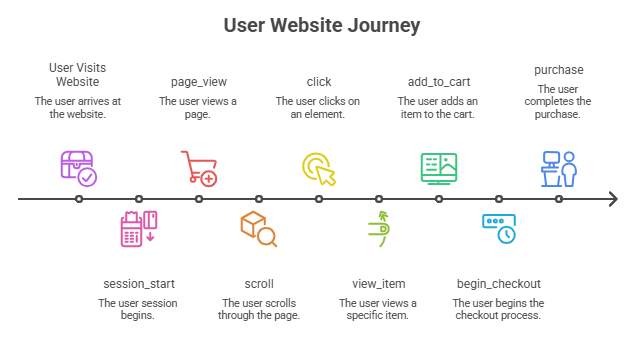
Each event can include additional information called parameters, providing context such as:
1. Page URL
2. Page title
3. Button text
4. Product name
5. Product category
6. Revenue
7. Currency
8. Device type
9. User location
For example:

This architecture enables businesses to analyze user interactions with much greater precision than traditional page-based tracking.
Why GA4 Is Different from Previous Versions?
Google Analytics 4 represents a fundamental shift in digital analytics rather than a simple upgrade to Universal Analytics.
The most significant change is the move from a session-centric model to an event-centric model. In Universal Analytics, many interactions required special tracking configurations and were stored in separate hit types. GA4 standardizes all interactions as events, making implementation more consistent and scalable.
Other notable differences include:
1. Unified tracking across websites and mobile apps.
2. Built-in enhanced measurement for common user interactions.
3. Improved cross-device user identification.
4. AI-powered predictive metrics and automated insights.
5. More flexible reporting through Explorations.
6. Better support for privacy regulations and consent management.
7. Native BigQuery export for advanced data analysis.
8. Modern attribution models focused on the complete customer journey.
These improvements make GA4 better suited for today’s digital environments, where customer interactions occur across multiple platforms and privacy requirements continue to evolve.
Who Should Learn Google Analytics 4?
Google Analytics 4 is valuable for anyone responsible for measuring, analyzing, or improving digital performance.
1. Digital Marketers: Track campaign performance, evaluate traffic sources, measure conversions, and optimize marketing ROI.
2. SEO Professionals: Analyze organic traffic, landing page performance, user engagement, conversion rates, and content effectiveness.
3. PPC Specialists: Measure advertising performance across Google Ads and other paid marketing channels.
4. Web Analysts: Build reports, dashboards, funnels, user segments, and actionable business insights.
5. Product Managers: Understand user behavior, feature adoption, customer retention, and product engagement.
6. Developers: Implement event tracking, configure Measurement Protocol, integrate Google Tag Manager, and validate analytics implementations.
7. Ecommerce Businesses: Monitor customer journeys from product discovery through purchase while optimizing checkout performance and revenue generation.
8. Business Owners and Decision Makers: Use analytics to evaluate business growth, customer acquisition strategies, marketing effectiveness, and overall digital performance.
Whether you are a beginner entering digital marketing or an experienced enterprise analyst, GA4 has become an essential skill in the modern analytics ecosystem.
GA4 Learning Roadmap
To master Google Analytics 4 effectively, it’s important to build knowledge progressively rather than jumping directly into advanced reporting or implementation. The roadmap below follows a logical sequence from fundamentals to enterprise-level analytics.
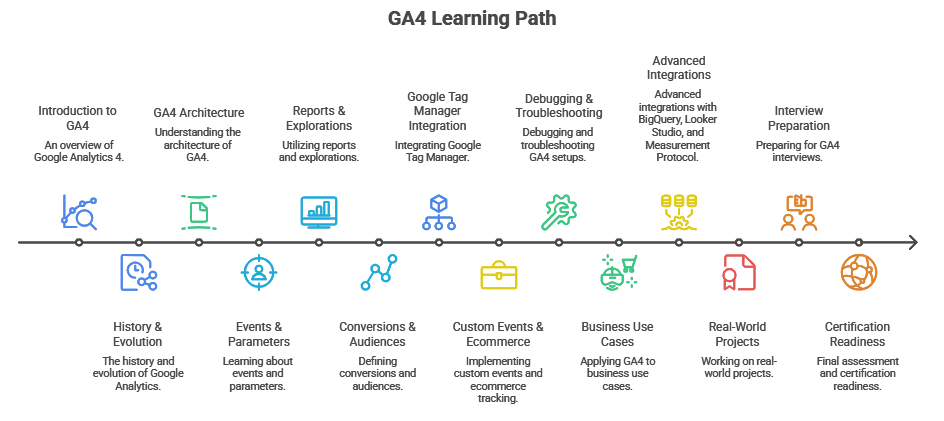
By the end of this guide, you will be able to:
1. Understand the complete GA4 data model.
2. Configure a GA4 property from scratch.
3. Implement tracking using Google Tag Manager.
4. Create custom events, conversions, and audiences.
5. Analyze reports and build meaningful dashboards.
6. Debug implementation issues confidently.
7. Apply GA4 to real business scenarios.
8. Prepare for GA4 implementation and analytics interviews with confidence.
Key Takeaways
🔵 Google Analytics 4 is an event-based analytics platform designed for websites and mobile apps.
🔵 It was built to replace Universal Analytics with a more flexible, privacy-conscious, and AI-powered measurement framework.
🔵 Every user interaction is captured as an event enriched with parameters, enabling deeper behavioral analysis.
🔵 GA4 supports cross-device tracking, predictive analytics, enhanced measurement, and advanced reporting.
🔵 It is an essential skill for marketers, analysts, developers, SEO professionals, ecommerce teams, and business leaders.
🔵 Mastering GA4 begins with understanding its architecture before progressing to implementation, reporting, and business applications.













Leave a Reply