
If you blinked in January, you probably missed something important.
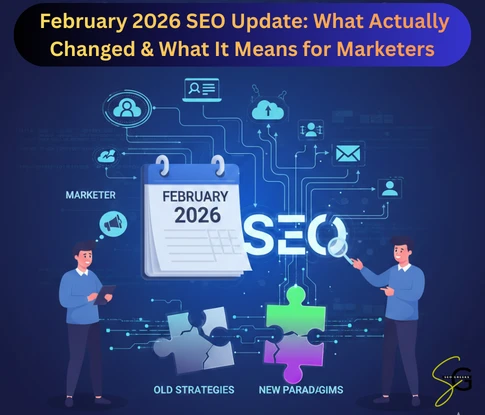
The February 2026 SEO Update isn’t about one single Google algorithm change. Instead, it’s about something bigger — AI integrations, commerce shifts, ad platform upgrades, and search behavior changes that quietly reshape how traffic, conversions, and revenue will work in 2026.
At SeoGreeks, we don’t just track updates — we analyze their business impact. So let’s break this down in a conversational way.
Because honestly? January 2026 wasn’t “just another month.”
1. Google Is Moving From Search Engine to Sales Engine
The biggest shift came with UCP (Universal Commerce Protocol) and AI-powered checkout flows.
Google now allows users to purchase directly inside AI chat interfaces using Google Pay – without visiting your website.
Let’s pause.
For years, the SEO funnel looked like this:
Search → Click → Website → Checkout → Revenue
Now it’s becoming:
Search → AI Interface → Direct Checkout → Revenue (with Google taking a cut)
Impact:
- Fewer website visits
- More zero-click transactions
- Google is entering payment commission territory
- Potential drop in eCommerce organic traffic
This is not just an SEO change. This is a business model change.
If your strategy depends heavily on transactional SEO pages, you need to rethink attribution and conversion tracking.
——————————————————————————————————————————————
2. AI Mode Expansion: More Push Toward AI Overviews
Google is now aggressively pushing users from traditional search results into AI Mode via “Show More” triggers.
Click that button — you’re no longer in standard search.
Impact:
- CTR from organic results may decline further
- Informational queries will increasingly stay inside AI responses
- Brand recall becomes more important than ranking alone
SEO in 2026 isn’t about “Rank #1.”
It’s about:
- Being cited inside AI responses
- Being trusted by AI systems
- Owning topical authority clusters
At SeoGreeks, we’re already advising clients to build AI-citable content blocks, structured data depth, and entity-based authority.
——————————————————————————————————————————————
3. Gemini Personal Intelligence: Hyper-Personal Search
Gemini now accesses Gmail, Photos, Calendar, and YouTube history (if permitted) to personalize answers.
This means two users searching the same query may see different responses.
Impact:
- Search results are becoming user-context driven
- Keyword ranking reports lose absolute accuracy
- SEO tools will need behavioral segmentation
The future isn’t just keyword-based SEO.
It’s:
- Contextual SEO
- Behavioral SEO
- Personal intent mapping
And yes, traditional rank tracking will become less meaningful over time.
——————————————————————————————————————————————
4. Google Tag Gateway (First-Party Tracking)
Google launched Tag Gateway (beta), serving Analytics and Ads scripts via your domain to bypass ad blockers.
Impact:
- More accurate conversion tracking
- Better visibility from Safari/Brave users
- First-party data becomes critical
With privacy regulations evolving, brands that don’t build strong first-party data ecosystems will struggle.
This aligns with the broader shift:
Third-party cookies ↓
First-party tracking ↑
Smart marketers will combine:
- CRM
- Email data
- Server-side tracking
- AI insights
——————————————————————————————————————————————
5. Performance Max & Total Budget Automation
Google increased video limits in Performance Max and introduced Total Budget campaign control.
More automation.
More AI distribution.
Less manual control.
Impact:
- High-budget advertisers benefit
- Creative diversity becomes crucial (video fatigue is real)
- Budget pacing becomes algorithm-driven
This means creative testing > manual bid adjustments.
In 2026, your performance edge will come from:
- Better creatives
- Better messaging
- Better data signals
Not micro-managing bids.
——————————————————————————————————————————————
6. ChatGPT Ads Launch
OpenAI launched ads for free users.
But here’s the catch:
- No deep targeting
- Pay per 1,000 views
- Limited analytics
Impact:
- Early-stage ad experiment
- Branding play more than performance marketing
- Not yet a Google Ads replacement
Despite the “Google is dead” narrative, ad ecosystem dominance still belongs to Google.
For now.
——————————————————————————————————————————————
7. Google + Apple Partnership (AI Infrastructure)
Google Cloud powering Apple foundation models is huge from a credibility and infrastructure standpoint.
Impact:
- Gemini credibility increases
- Google strengthens AI ecosystem positioning
- Enterprise AI trust grows
AI wars are no longer about chat interfaces.
They’re about:
- Infrastructure
- Commerce
- Payment control
- Search dominance
——————————————————————————————————————————————
What This Means for SEO in 2026
Let’s simplify the February 2026 SEO Update impact into five strategic realities:
| SEO Update | Impact |
|---|---|
| SEO Is No Longer Just Traffic | It’s about visibility inside AI systems. |
| CTR Will Decline for Informational Queries | Zero-click searches are becoming standard. |
| Commerce Is Moving Inside Search | Your checkout may not always happen on your site. |
| First-Party Data Is Power | Tracking accuracy will differentiate winners from losers. |
| Brand Authority > Keyword Position | AI cites trusted brands — not just optimized pages. |
——————————————————————————————————————————————
How SeoGreeks Approaches 2026 SEO
At SeoGreeks, our framework now includes:
- AI Visibility Optimization (AIO)
- Answer Engine Optimization (AEO)
- Entity-based SEO mapping
- First-party data architecture
- Conversion tracking validation
- AI-citable content structuring
- Structured data enhancement
- Topic cluster authority building
Because ranking alone is outdated thinking.
Search is evolving into:
- AI-assisted commerce
- Personalized information delivery
- Platform-controlled monetization
——————————————————————————————————————————————
Final Thoughts
If you’re waiting for a “big core update announcement,” you’re missing the point.
The real February 2026 SEO Update isn’t one algorithm change.
It’s a structural transformation of:
- Search behavior
- Monetization models
- AI integration
- Data ownership
And here’s the truth:
SEO in 2026 belongs to brands that:
- Build trust
- Build authority
- Build data assets
- Adapt to AI ecosystems
If your strategy still revolves around “add more keywords and backlinks,” you’re playing 2020 SEO in a 2026 battlefield.
The shift has already started.
The question is — are you optimizing for search engines…
Or for intelligent systems?
— Team SeoGreeks.








Leave a Reply